
The Roman army once conquered the world, but the Roman empire was ultimately brought down by primitive tribes. Are we seeing the decline of the U.S. empire?
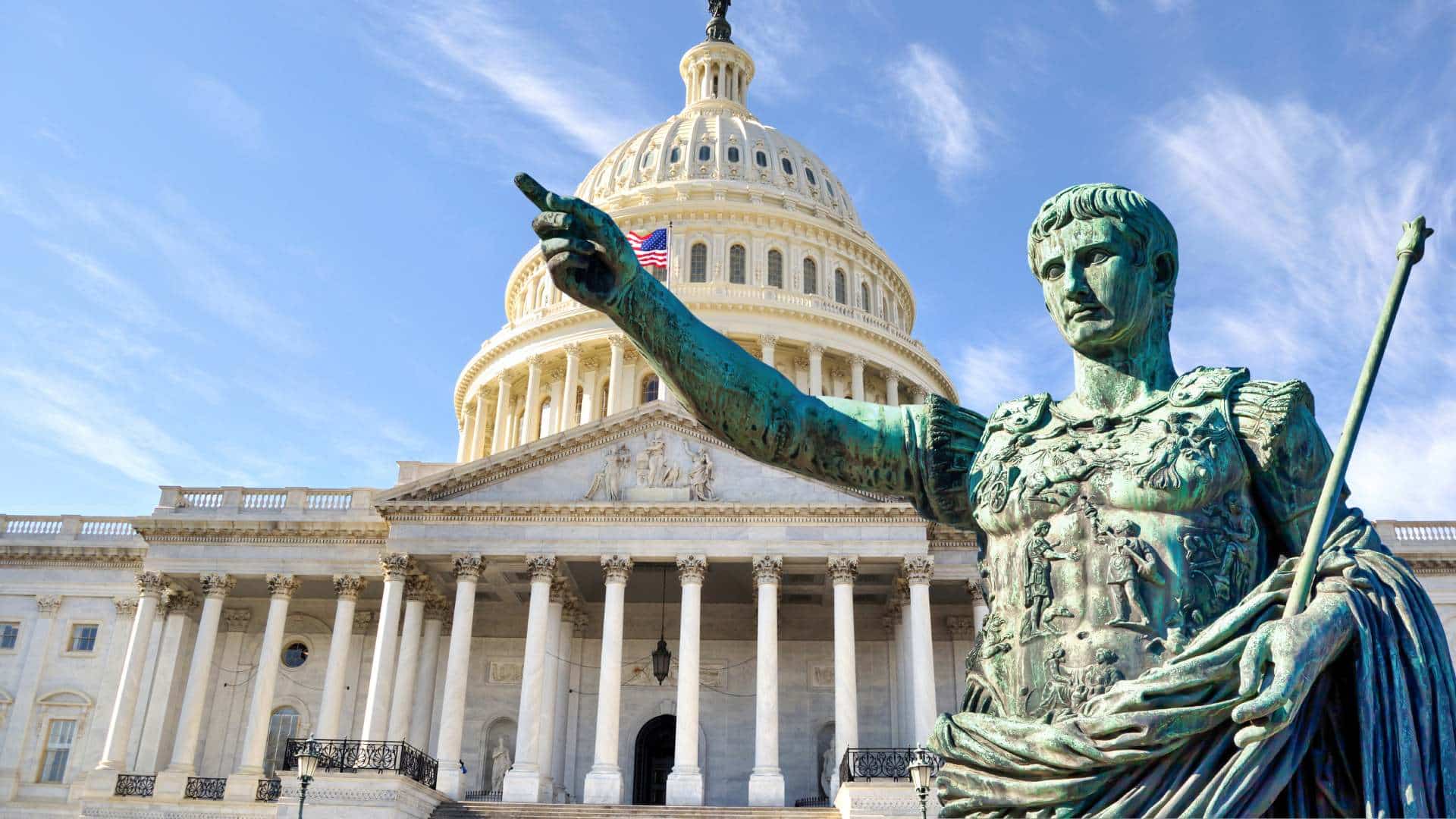
Statue of Caesar superimposed on U.S. Capitol. Illustration by News Decoder.
Editor’s note: Since the beginning of the second presidential term of Donald Trump, which began in January 2025, the United States military has launched military actions against Venezuela, Nigeria, Syria, Somalia, Yemen, Iraq and Iran. The new willingness of the U.S. government to attack foreign countries without first establishing broad alliances with allies is leading many political scientists and historians to question whether the nation has lost its role as a global superpower.
To help put this into perspective, we are republishing an article by correspondent Gene Gibbons, first published in September 2021, that explores how the role and standing of the United States on the world stage has changed ever since the terrorist attacks on the World Trade Center and Pentagon building in 2001.
We launched Decoder Replay to help readers better understand current world events by seeing how our correspondents decoded similar events in the past.
The parallels are eerie.
Ancient Rome, a superpower with sophisticated governance and a fearsome military, brought to its knees by a primitive rabble basically armed with sticks and stones.
The United States of America, an even more awesome colossus, knocked off its pinnacle two thousand years later by a small group of Islamist extremists who turned airliners into guided missiles, an unanticipated form of asymmetrical warfare.
As we mark the 20th anniversary of the 9/11 attacks by Islamist extremists on the United States, one wonders if al Qaeda succeeded beyond its wildest dreams, rivalling what the Visigoths accomplished.
The Germanic tribes, now collectively known as the Visigoths or Vandals, harassed Rome for years, of course, before the Roman Empire collapsed. It was death by a thousand cuts also brought on by pride, corruption, strategic over-reach and other political mistakes.
Fear of attacks
In the 20 years since jihadists headed by Osama bin Laden mounted an astonishing assault on the centers of U.S. financial and political power, a similar unravelling arguably has occurred in the United States.
I think we Americans tend to forget what a psychic shock the attacks delivered to our nation. That’s understandable. 9/11 occurred a generation ago.
But in the immediate aftermath, there were widespread fears that a second wave of attacks was inevitable, possibly involving radiation-spewing “dirty bombs” or even a nuclear device. Those fears were taken seriously at the highest levels in Washington.
Radiation-sniffing airplanes flew over the U.S. capital, and presumably other major cities, at regular intervals. Air travel became and continues to be an ordeal, with pre-boarding searches and onboard passenger vigilance of anyone who looks strange or acts suspiciously.
The latter behavior paid off on two separate occasions in the years just after 9/11 when would-be militants tried to set off explosives on U.S.-bound international flights.
The public paranoia has had enormous U.S. political consequences, setting off a chain reaction that, I believe, largely brought us to where we are today: a confused, fearful, badly divided country where the default response to even the most minor problem is to lash out against fellow Americans and the international community. A country that has lost its way.
A superpower scared
Xenophobia and nativism have always been simmering ingredients of our politics, but they’re now at a boiling point.
Domestically, the 9/11 attacks brought The Patriot Act, legislation that authorized previously unthinkable invasions of privacy. There was the militarization of local police, who were showered with battlefield equipment and who, in many locales, often began acting like occupying troops rather than peace officers sworn to serve and protect the citizenry.
Those were among a number of well-intentioned actions that have helped fuel increasing distrust of government and accelerating public unrest.
In foreign policy, many informed observers believe the al Qaeda attacks on September 11, 2001 triggered a cascading series of strategic errors, starting with Afghanistan.
The initial U.S. mission was clear: track down bin Laden and topple the Taliban. Before accomplishing either — bin Laden escaped to bedevil America for another decade and the Taliban went underground — the mission became a grand vision: remake Afghanistan in America’s image, secure equal rights for girls and women, improve Afghan health and education and better Afghan living conditions.
Making the world safe for democracy
While they were at it, U.S. policymakers decided to try to make the volatile Middle East safe for democracy by ousting Saddam Hussein from power in Iraq. The Gulf region became the priority, Afghanistan a backwater.
The Iraq adventure backfired by empowering Washington’s nemesis Iran and giving rise to the Islamic State of Iraq and Syria (ISIS), which aims to establish a caliphate, or fundamentalist Muslim theocracy, throughout the region that once was the Ottoman Empire.
Like a deadly cancer that might be held in check for a while only to reappear in a patient as an even more lethal threat, ISIS now seems to be metastasizing.
Historians cite the Battle of Adrianople in present-day Turkey, ironically the same general region where the United States lately has come to grief, as the death blow of ancient Rome. In that battle in 378 A.D., the Goths overwhelmed an over-confident Roman emperor, Flavius Valens, and slaughtered him and two-thirds of his numerically superior force.
On U.S. cable television and in social media — a modern-day equivalent of Rome’s Agora as a forum for the discussion of public issues — a full-throated blame game now ranges over the wreckage of post-9/11 American policy. It makes the venomous political atmosphere that already exists in the United States because of economic, racial and cultural differences even more poisonous. The same thing happened in Ancient Rome.
“The past is never dead. It’s not even past,” novelist William Faulkner famously remarked. Is history repeating itself? The evidence suggests there’s much cause for concern.
Questions to consider:
1. What happened in the United States on September 11, 2001?
2. The author says many experts believe the United States committed strategic errors after 9/11. What errors?
3. Do you believe that the United States is losing its superpower status? If so, why?

Gene Gibbons covered U.S. Presidents Nixon, Ford, Carter, Reagan, George H.W. Bush and Clinton during his career with Reuters and UPI. He was past president of the Radio-Television Correspondents Association and served as a Presidential Debate panelist in 1992 and as a Joan M. Shorenstein Fellow at Harvard’s Kennedy School of Government in 2010. An ex-U.S. Army officer, he once served as press aide to U.S. Vice President Hubert Humphrey. He is the author of the book "Breaking News: A Life in Journalism."