
Grapes are notoriously sensitive to weather. That leaves grape growers struggling to adapt to the long-term effects of climate change.
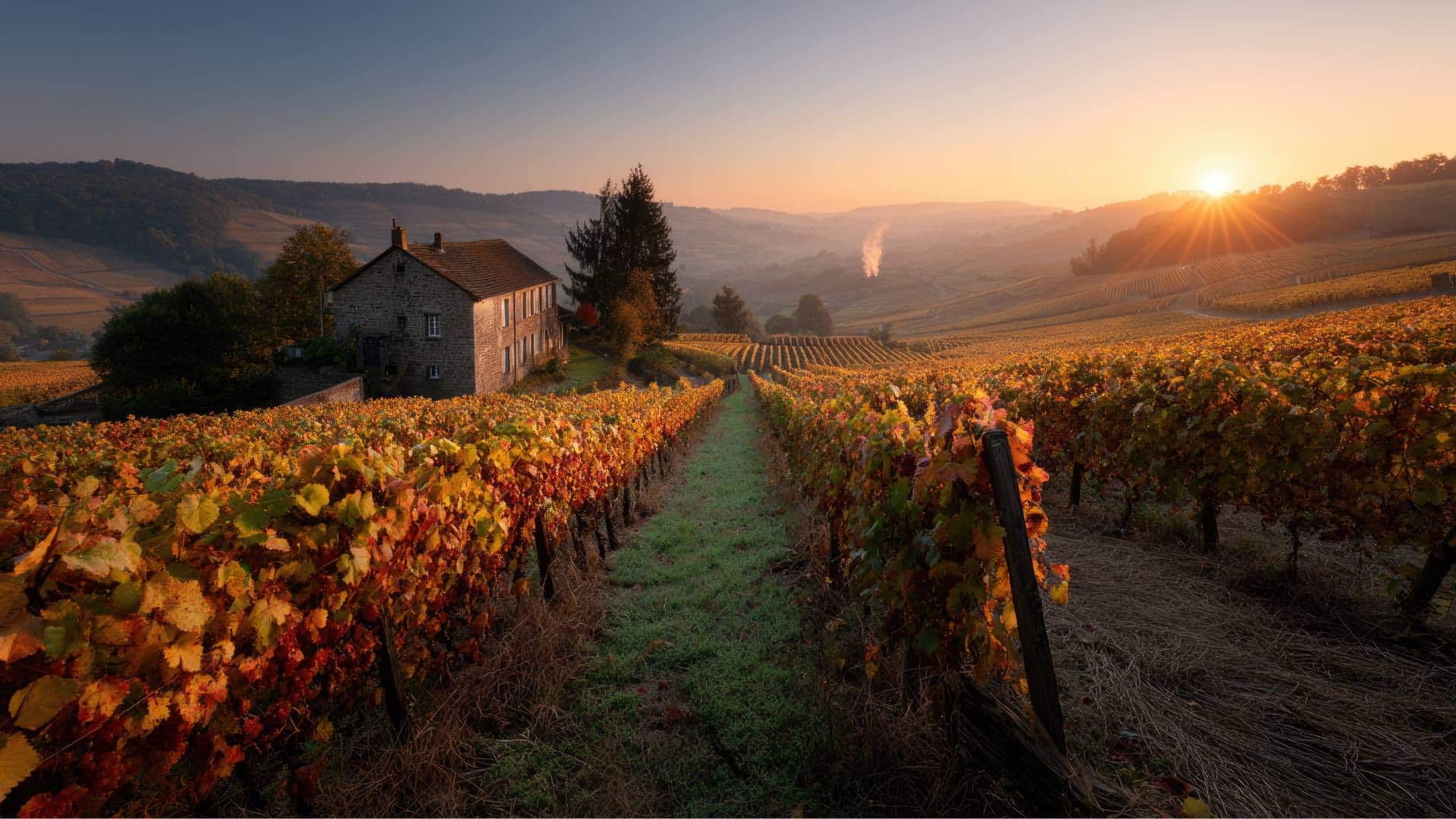
A vineyard in the Wallonia region of Belgium glows with autumn colors, the vines stretching in neat rows across rolling hills. (By Laviender/Adobe)
This article, by high school student Slav Karaslavov, tied for second place in the 18th News Decoder Storytelling competition. The story was produced out of News Decoder’s school partnership program. Slav is a student in the Climate Academy program at the European School of Brussels II, a News Decoder partner institution. Learn more about how News Decoder can work with your school.
It is another early harvest for the Vignoble des Agaises, a vineyard in the region of Mons in Belgium. While the country is widely known for its variety of Trappist beers, the proximity that Mons and the region of Wallonia bears to French Burgundy and Picardie influences the local drinking culture.
Indeed, wine means a great deal to Arnaud Leroy, the vineyard’s sales manager. He and his family have, for 20 years now, pioneered the potential of the frontier that is Southern Belgium in the production of champagne and other sparkling wines.
Wine has been a staple of the regional economy and culture for centuries and has been a vital part of Leroy’s life and that of millions of other people around the world. Recently, however, a series of early frosts have decimated large quantities of the harvests in the lands stretching from Lombardy to Flanders.
These poor harvests have left many local vineyards in a state of financial uncertainty. Such events aren’t unique to the regions of Western Europe. Similar problems and hardships have been experienced in most other winemaking regions of Europe and have caused harm to winemaking communities around the world.
Europe has been hit by what may only be compared to a “tidal wave” of change as previously predictable and constant meteorological conditions that have allowed winemaking to prosper in these regions for millennia have been altered significantly in the span of nearly a few decades.
“In the last 10 years we have always harvested in October,” Leroy said. “But recent harvests have systematically been earlier and earlier into September, this year’s harvest being around the third of September.” This seemingly light change may have an outsized impact on the nature of the wine produced, deeply affecting the wine’s taste and composition.
With wine, climate is everything.
Wine is widely regarded as one of the most climate-sensitive crop cultures, experiencing possible changes to its texture, taste and tannin density from even the smallest constant meteorological change.
Earlier harvests can affect the wine’s taste, as a low maturation of the grapes may cause an increased sourness and a less sweet taste as well as a lighter, less-defined aroma, while spring frosts like the ones experienced in the last few years may cause the exact opposite, making a much sweeter, less-acidic and more tannin heavy wine.
Thus, the taste of many well-established sorts and brands of wines may be inconsistent and altered significantly by the seasonal changes brought by the climate crisis. Renowned regions such as Tuscany, Burgundy, Greece, the Rhine Valley, California and many more may be considerably different — and potentially even in danger of being displaced in a few decades.
Indeed, it would seem one of Europe’s oldest industries is in a crisis. Wine has been a luxury product for thousands of years and holds a cultural, economic, social and historical value that few other comparable goods hold.
Associated with the higher class and nobility for centuries and being a valued good for over 10 millennia, wine is arguably one of Europe’s most important goods. It holds a vital place in Christian tradition and practice and — having two saints and a multitude of deities of hundreds of religions and mythologies — it is perhaps one of the most important components to the cultural development of the continent and perhaps, of the world.
Addressing climate change
The changes experienced in the last decades have not gone unnoticed. Many oenologists and vintners have called for more attention and action in the fight against climate change and the seasonal changes it may bring. What is now often called a crisis is even further fueled by other external causes.
“The younger generation simply consumes less alcohol,” Leroy said. This makes the financial impact of said seasonal effects even more devastating to the smaller domaines and vineyards while bigger producers cling on to what is left of their harvests.
This year’s harvest has been plentiful and record-breaking in some regions such as Champagne, mostly due to favourable conditions and the development of better technology. But this success has taken media attention away from the longer term crisis.
In the summer of 2025 large floods hit the regions of Picardie in Belgium and Champagne in France, causing two deaths and large amounts of damage to private property and agricultural lands, further hindering the European wine market.
Even worse, in the case of an increase of two degrees Celsius (35 degrees Fahrenheit) of global temperatures, scientists warn that the world may pass a tipping point (a point of irreversibility) in the patterns of ocean currents, potentially causing drastic change to the European climate as we know it — a threat that has been mostly ignored by mass media and climatological institutions.
And that threat is only about 20 years from now.
Some grapes suffer, others thrive.
This doesn’t mean, however, that absolutely all regions will suffer and that there are no solutions. In some southern parts of Sweden for instance, a multitude of new, more resilient vines have laid the foundation for a Scandinavian wine industry, made possible due to the changes experienced in the local climate.
“While there have been some exceptions, notably in 2024, wine production has been top quality,” Leroy said. “The earlier harvests have their advantages.”
As older, more renowned wine producing regions lose their significance, this instability may prove a good time for newer regions and producers with other defined traits such as Scandinavia, the Balkans and the Agaises vineyard with their chalky ground and distinct latitude to fill in the gap left by the older producers.
Of course, a solution to the entire issue would be the halting or at least the delaying of climate change through the lowering of consumption and of carbon emissions. But such halting would take a tremendous individual and national effort that is lacking in Europe and in the world.
Thus, this problem presents us with yet another reason to continue the costly yet imperative fight against the climate crisis and all effects that it causes.
Questions to consider:
1. What does the author mean by a “tidal wave” of change that has hit Europe?
2. How can climate change help grape growing in some regions when it devastates other regions?
3. Can you think of other long-time industries that have been affected by climate change?

Slav Karaslavov is a student at the Climate Academy at the European School of Brussels II in Belgium. He is a native of Bulgaria. He has always had an interest in writing