
Among the lush greenery of Maui, some spectacular birds are dying out. A group of conservationists is working to bring these populations back to life.
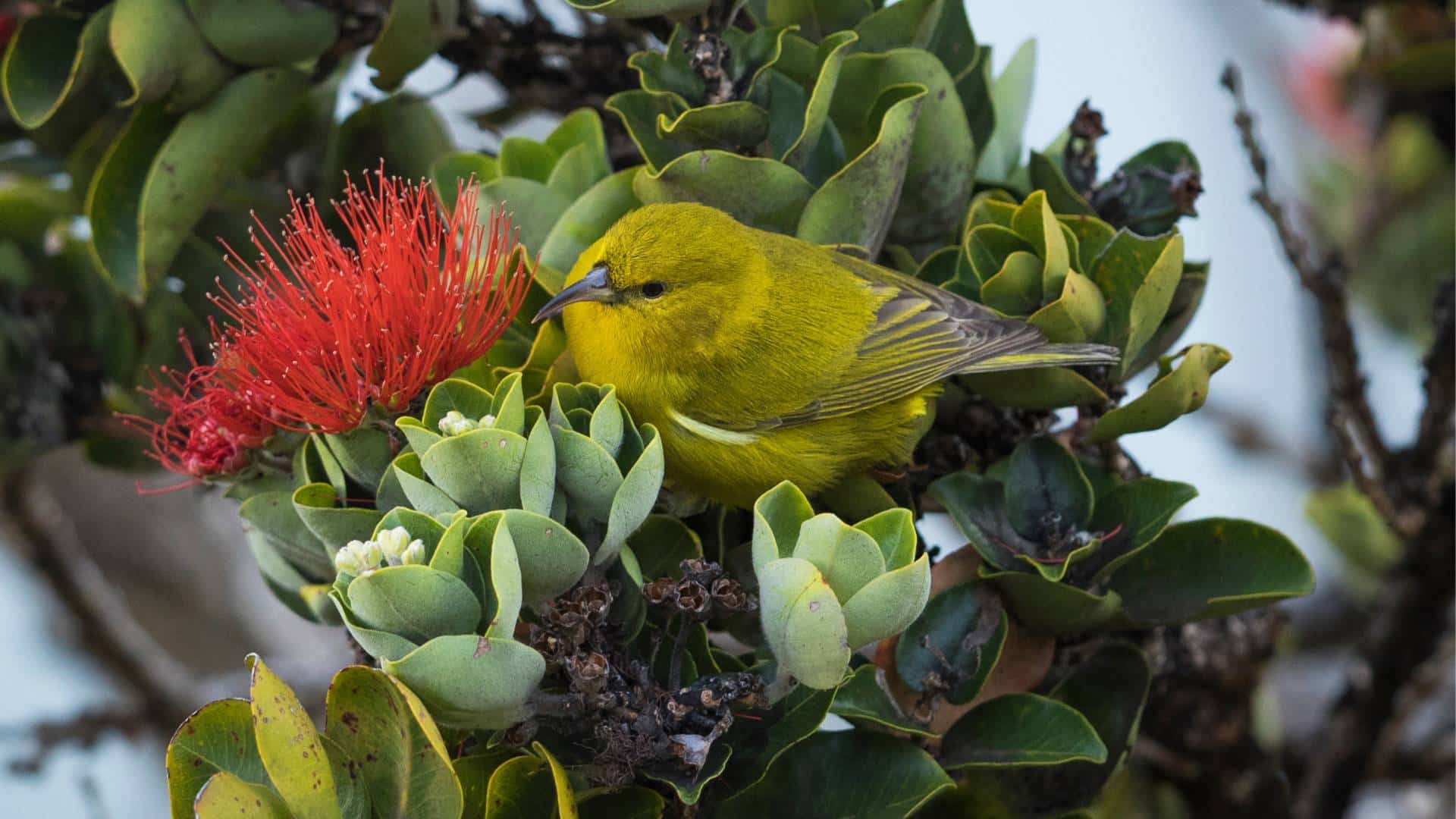
The Hawaii ʻamakihi in an ʻōhiʻa lehua tree. (Photos courtesy of the Maui Forest Bird Recovery Project)
This article was produced exclusively for News Decoder’s global news service. It is through articles like this that News Decoder strives to provide context to complex global events and issues and teach global awareness through the lens of journalism. Learn how you can incorporate our resources and services into your classroom or educational program.
Aviculture specialist Tess Hebebrand eats lunch by a waterfall in Maui, the second largest Hawai’ian island. She spots a Hawai’ian crow, or ʻalalā, hanging out nearby. The bird is one of only five of its species flying free on the island — in fact, one of only five flying free in the world.
“I see one of my favorite ʻalalā taking a break on the side of a waterfall,” Hebebrand said. “I’m sitting there in the forest and look up to see a bird foraging around me, peering down at me and going on with his day.”
Hebebrand calls this casual ʻalalā encounter a favorite moment in the field. In her work with the Maui Forest Bird Recovery Project, Hebebrand maintains bird feeding stations and tracks the habits of the ʻalalā in the Kīpahulu Forest Reserve.
A year ago, five juvenile ʻalalā, raised in captivity, were released in Kīpahulu as part of a pilot project to restore the species, which faces extinction.
About 100 ʻalalā live in captivity. These are all that remain.
Birds on Maui face multiple threats.
Only a handful of native birds still live on the Hawai’ian islands. About two-thirds of native bird species were lost to avian malaria and other diseases spread by mosquitos. The insects were introduced to the island by whaling ships in the 1800s. Other birds have been lost to predators — rats, mongoose, cats — that kill birds and ransack nests.
Now global warming endangers the few remaining species of birds who’d moved to higher elevations too cool for mosquitos to thrive. As air warms, the insect population increases, threatening the few remaining native birds.
The Maui Forest Bird Recovery Project combats native bird extinction on several fronts. Workers address the mosquito problem by releasing sterile male insects to mate with females. The females then lay eggs that never hatch. Teams also maintain humane traps for predators. They track dwindling bird populations and raise native birds in captivity with the hopes of eventually releasing these birds into the wild, as they did with the ʻalalā in 2024.
The good news? All five of the released ʻalalā have made it through a year of freedom. One male and female mated last spring and built a nest together.
“We were pretty excited that the pair built a nest and we confirmed one egg, pretty incredible,” Hebebrand says. “It didn’t hatch. She sat on the nest, though, and he cared for her.”
It’s a good sign. The birds were young, at least a year away from reproductive years. In the wild, the ʻalalā start reproducing around the age of three and live into their teens.
A bird survival strategy
The goal, says Jessica Eden, Maui Forest Bird Recovery’s education specialist, is to have a self-sustaining native population back on Hawai’i.
So far, efforts to restore ʻalalā on Hawai’i have not been successful. Releasing the ʻalalā on Maui removed one threat to the birds’ survival: the Hawai’ian hawk that preys on ʻalalā.
“They’re Big Island birds,” Eden says. “They are on Maui to learn about being in the wild and we’re here to learn from them.”
Hebebrand and coworkers from Hui ʻAlalā camp for a week at a time on the leeward slope of Haleakalā, a dormant volcano that makes up 75% of the island Maui. A helicopter takes workers to the site. The terrain is rough and steep, thick with native koa trees (a species of acacia), ʻōhiʻa lehua (a flowering evergreen) and native fruit trees.
The five ʻalalā wear plastic color bands familiar to the team. Team members identify the birds with binoculars, observing their behavior.
“They’re very charismatic,” Hebebrand says. “We spend a lot of time watching and caring for them.”
The social life of birds
Hebebrand describes the birds as loud, and like other corvid species, social. They meet up at feeding stations to groom and feed each other. They forage for food together. The birds seem to recognize members of Hui ʻAlalā.
“But they don’t wanna hang out with us,” Hebebrand says. “They’ll alarm call us and then go ‘oh it’s you’ and move on.”
Hebebrand appreciates her job.
“To see them living their lives in the forest,” she says, “that’s pretty incredible.”
A highlight of Sonia Vallocchia’s work came during an internship on the island of Mauritius. She’d spent countless hours roaming the island, searching for signs of a tiny critically endangered bird, the Mauritius Olive White-eye.
“Their nests are difficult to find and small,” Vallocchia says. To find one gave her a sense of achievement, a hope for the species that’s endemic to the island, found nowhere else.
Learn more about conservation efforts across the globe
Bringing back birds
Vallocchia’s work has also taken her to Malta and Mexico. She’s been with Maui Forest Bird Recovery for four years. As avian research field supervisor, she works on honeycreeper surveys, counting the relatively few remaining birds from what was once a thriving bird paradise with more than 50 species of honeycreeper.
On Maui, Vallocchia says, six species of honeycreeper remain. Three of these are endemic to Maui, found nowhere else. Vallocchia and her colleagues track populations of Kiwikiu (Maui parrotbill) and ʻĀkohekohe (crested honeycreeper).
Vallocchia and her colleagues camp out in various locations on Maui, tracking birds and their activities at predetermined spots or transects on a specific line through a forest. This gives them a consistent scientific way to count the birds.
Right now, fewer than 150 kiwikiu remain, Vallocchia says.
“The native birds, you see how special they are here,” Hebebrand says. “When I saw a kiwikiu in the wild for the first time, I cried.”
The soundscape of Hawaii
Some native birds are spotted closer to the project’s home office. A Hawai’i ‘amakihi was spotted recently feeding on a hibiscus plant in the yard, delighting the staff.
Program manager Hanna Mounce describes the work of Maui Forest Bird Recovery Project as an investment in ecosystems, cultural connections and the next generation.
“I’m hopeful that our work today will help ensure these birds are still here for our children and grandchildren,” Mounce says. “Every day, I work alongside a team deeply committed to protecting something bigger than themselves.”
Hawai’ian birds often make the sounds of their names. The kiwikiu might screech keee-eee-eee or tree-tree or kiwi-kiwi-kiwi-kiwi.
“It’s so varied,” Vallocchia said.
What tourists don’t see or hear
These songs most likely won’t be heard by visitors coming to the islands on vacation. People relaxing at resorts may not know they’re missing the native wildlife and birds of the Hawai’ian islands.
“Millions of people visit Hawaiʻi every year,” says Chris Warren, forest bird program coordinator at Haleakalā National Park, “and only a fraction of those get a chance to see an ʻiʻiwi or other fabulous native birds. People can grow up here and never experience a native forest.”
Warren worked for MFBRP for more than a decade and continues to partner with the organization.
“The project has always been driven by passion and a deep desire to save these species from extinction,” Warren says. His own understanding of extinction dates back to his work at the Joseph Moore Museum of Natural History in Indiana. He encountered specimens of extinct birds like passenger pigeons and Bachman’s warblers.
“There is something profound about holding an animal in your hand that will never be seen alive again,” Warren says. “And to know that that extinction was preventable made a deep impact on me.”
Protecting without disturbing
Warren says one of the biggest challenges to forest bird recovery involves educating the public, who may not know these birds exist. People care more deeply about things that they’ve personally experienced, he says.
Vallocchia agrees. She invites visitors to explore accessible areas of Maui, hiking into its fragile forests with awareness and care.
“For people to want to protect something, they need to see it, experience it, understand the beauty of it,” Vallocchia says. “Being part of nature is not disturbing nature if it’s done in the right way.”
Camping with permits is possible in places like Haleakalā National Park.
“You could wake up to the song of the honeycreeper,” Vallocchia says.
Recommended:
The award-winning documentary “Vanishing Voices” combines interviews with bird recovery workers and animation to explain the science being used to save birds from extinction.
Questions to consider:
1. What are some threats to the honeycreepers on Maui?
2. How are conservationists trying to restore the population of alalā?
3. What birds can you spot where you live?
Want to see and hear some honeycreepers? Check out the video below:

Deidre Pike is a freelance writer and journalism professor at California State Polytechnic University Humboldt based in Arcata, California. She was an assistant professor of journalism at the University of Hawai’i at Mānoa in 2011–12.