
Ask people at random what countries emit the most greenhouse gases and you find we have a long way to go in educating people about climate change.
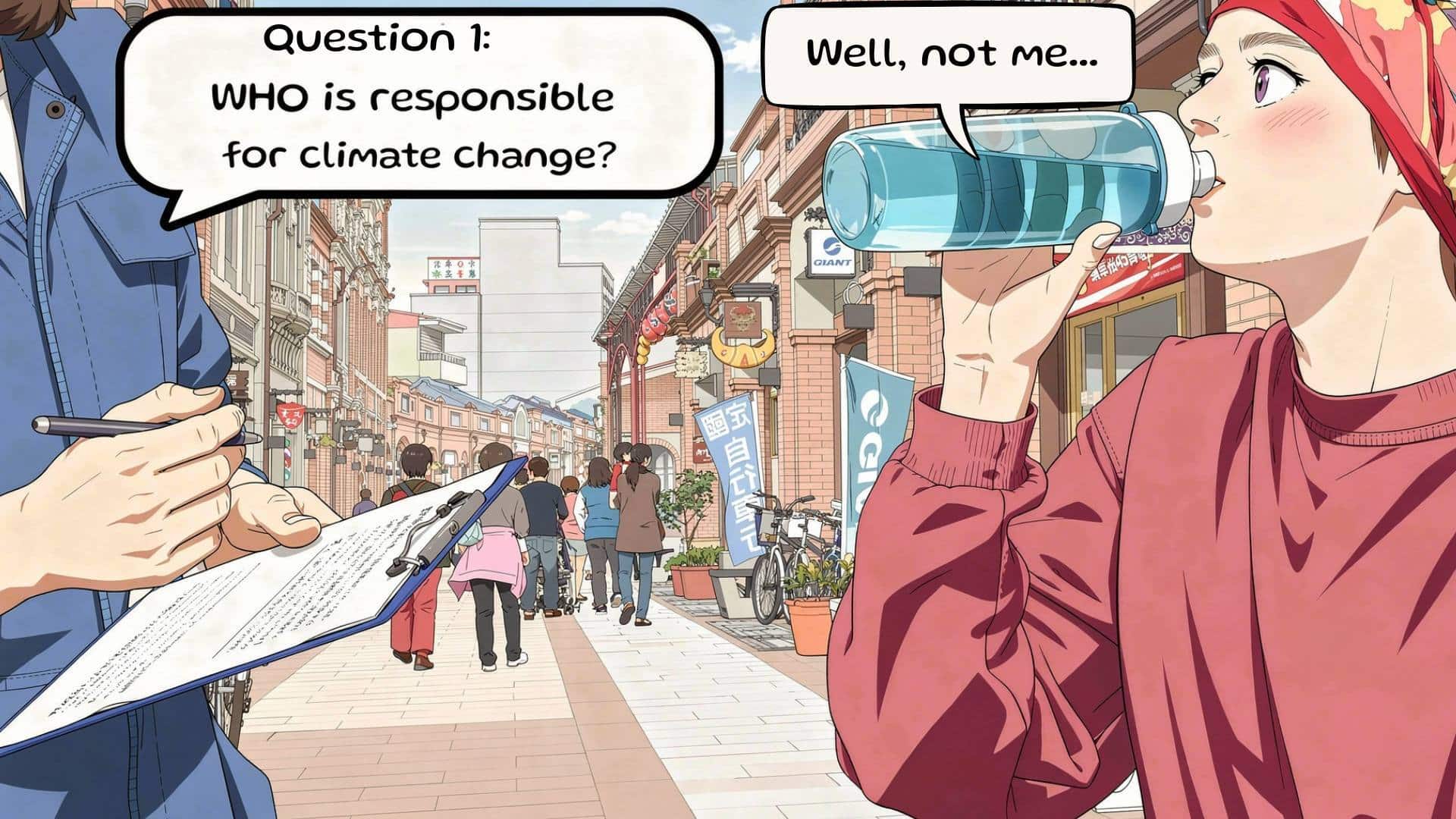
A surveyor asks a person on the street about climate change. (Illustration by News Decoder based on Canva image)
This article, by high school student Amaury Chauve tied for third place in the 18th News Decoder Storytelling Contest. The story was produced out of News Decoder’s school partnership program. Amaury is a student in the Climate Academy program at the European School Brussels II, a News Decoder partner institution. Learn more about how News Decoder can work with your school.
Do you know which country emits the most greenhouse gases per capita? If not, you aren’t alone.
I’m a student at The Climate Academy, an international organization founded by philosopher and climate activist Matthew Pye who teaches students about climate change from a systems point of view.
This year, we surveyed almost 500 people in Brussels, Varese and Milan to analyse the level of climate literacy among populations across Europe. Many people we surveyed pointed at large emitters such as the United States, China and India.
Yes, these are big emitters in quantity, but when it comes to per capita emissions — the amount divided by the population of the country — the top three are smaller, wealthy countries: Singapore, the United Arab Emirates and Belgium.
These numbers can be explained by the extremely consumeristic, luxury lifestyle of the overwhelming majority of their citizens and the over-reliance on fossil fuels for generating energy. Yet, in our survey, 378 people out of 468 — 81% — named the United States, China or India.
We must refocus the lens.
What does this mean? That the media attention is on the wrong players. As stated by the World Economic Forum:
“When India surpassed the European Union in total annual greenhouse gas (GHG) emissions in 2019 becoming the third largest emitting country after China and the United States, that statistic only told part of the story. India’s population is nearly three times larger than that of the EU, so based on emissions per person, India ranks much lower among the world’s national emitters.”
It is crucial to look at per capita emissions. That’s the conclusion of the Global Change Data Lab, a nonprofit organization that produces Our World in Data. It argues that annual national emissions do not take population size into account.
“All else being equal, we might expect that a country with more people would have higher emissions,” it reported. “Emissions per person are often seen as a fairer way of comparing. Historically — and as is still true in low- and middle-income countries today — CO2 emissions and incomes have been tightly coupled. That means that low per capita emissions have been an indicator of low incomes and high poverty levels.”
Europe often points at big emitters, but the comfortable lifestyles Europeans have due to their higher living standards aren’t sustainable.
Who to blame for climate change?
There’s a misconception that the more a country emits, the more responsible the country is for climate change.
This is the result of intense lobbying and voluntary misdirection by the richest. The wealthiest individuals are undoubtedly responsible for a considerably higher share of global emissions. But we’re often told that countries like China and India are the most responsible, as they are some of the world’s biggest polluters, a fact which is widely recognized.
Pye said it isn’t a surprise that the focus is on numbers at the macro level, as international organizations like the United Nations were created by the main global powers and they are still funded mainly by them.
“Keeping the language and the numbers about the problem general and global masks the fact that the majority of our [per capita] emissions are still from these rich nations,” he said. “This lack of clarity about who is responsible is reflected right across global media coverage. It is not by chance that we don’t have a clear view of the vital statistics, it is by subtle and powerful design.”
The UN is founded on the principle of human rights, he said.
“Should it not think and act on climate change with everyone having an equal right to the air?” Pye said. “When you look at per capita and consumption emissions the whole landscape of responsibility is radically different.”
Surveying people about greenhouse gases
I conducted my part of the survey in a middle-class neighborhood of Brussels.
When I asked a 20-year-old, “What would the consequences of a two degree increase in global temperature be?” I got this answer: “More meteorites.” When I put the same question to someone 50 years of age, the answer was, “It’s going to be cold.”
A 75-year old told me: “I don’t believe in climate change. There were examples of extreme heat in the 17th century, it is natural. Climate change is a tool of the government to control us.”
All of these are misconceptions about weather events, temperature patterns and the source and type of climate change we experience.
Now, this survey included only a small sample of the population. But it already shows that the misconceptions in education about climate change are real and existent across every generation and in many ways. Many other surveys made by reputable organizations have supported this conclusion.
What people don’t know
A 2010 report by the Yale University Program on Climate Change Education found that 63% of Americans believed that global warming was happening, but many did not understand why. In this assessment, only 8% of Americans had knowledge equivalent to an A or B, 40% would receive a C or D, and 52% would get an F.
A report by King’s College in London, based on a 2019 survey, found a similar level of ignorance.
Misconceptions are still here, waiting to be tackled. It starts in schools, where new, fresh generations without bias or misconceptions are formed. It starts at home, where parents should adapt and teach their kids the basics. Proper educational programs should be set up by governments.
This seems natural. But just a few months ago, in the United States, the Trump administration cut funding for schools that hold educational programs on climate change and greenhouse gas emissions reduction.
Educational systems, too, spread misconceptions about climate change. Because we never stop learning, educational systems shouldn’t have such flaws and should provide accurate information.
As we dive deeper into the climate crisis, proper knowledge and understanding will be key to systemic change and governmental response.
Until information on climate change becomes a public good, we will continue to “debate what kind of swimming costume we will wear as the tsunami comes.” Those are the words of then-U.S. Treasury Secretary Hank Paulson before the 2008 financial crisis.
Questions to consider:
1. Why is it important to consider the size of a population when considering responsibility for climate change?
2. What is meant by “climate ignorance”?
3. How can you learn more about climate change?

Amaury Chauve is a student at the European School of Brussels II. He is part of the Climate Academy and is interested in sustainable development. In his free time, he plays piano, basketball and practices card magic.